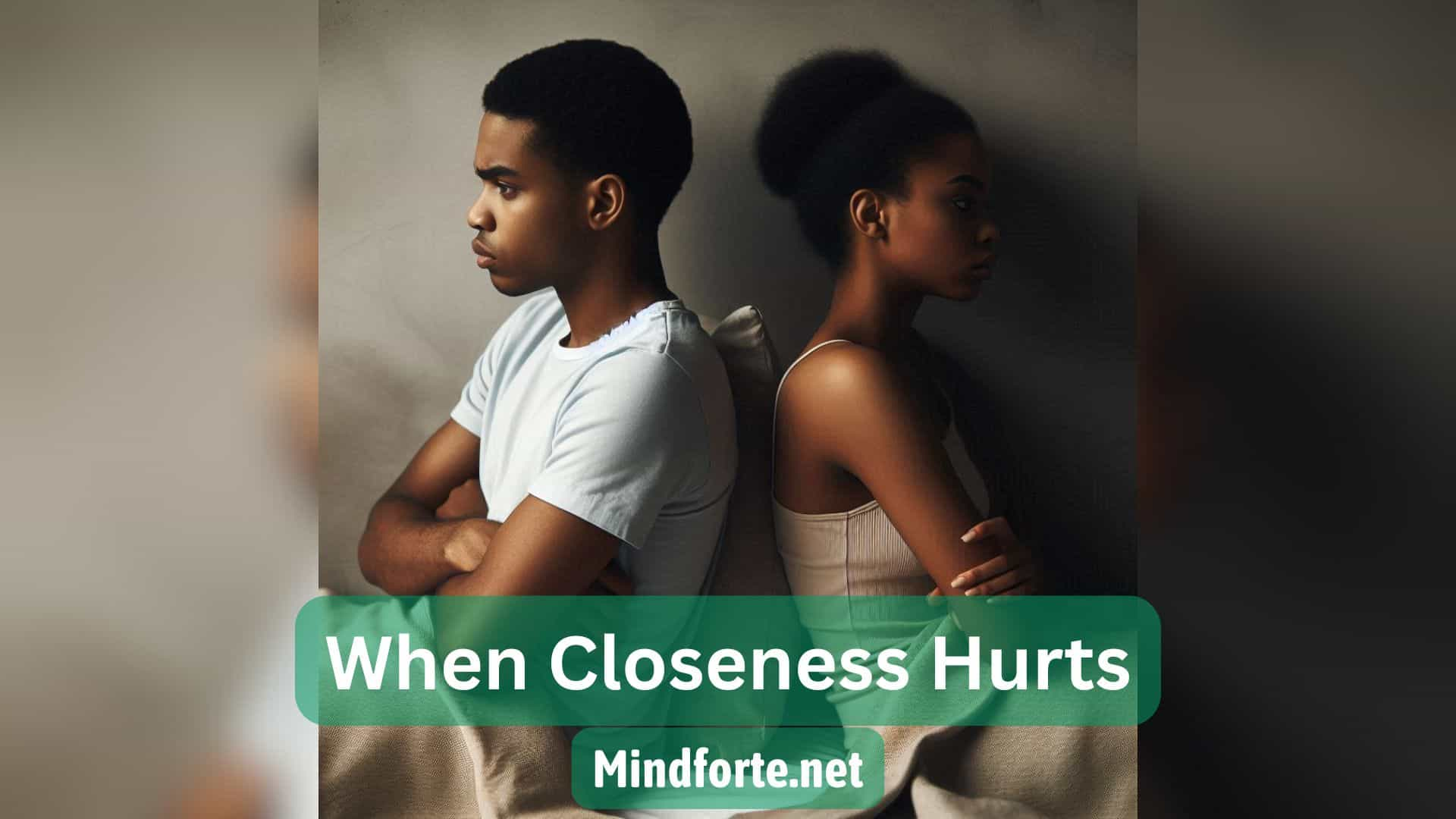
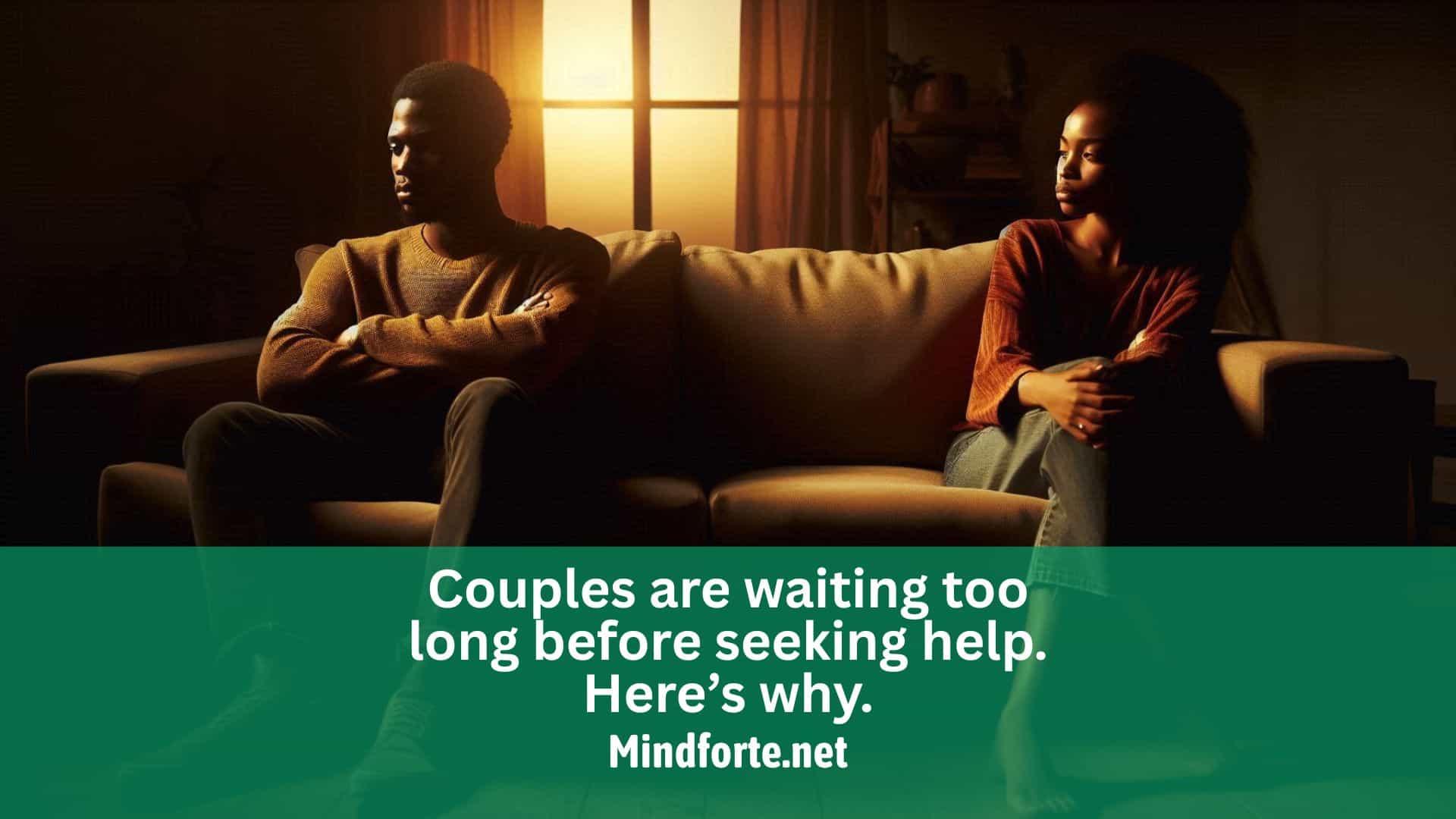
Many couples quietly wonder: “Are we stuck, or do we need real help?”
Some search online for a therapist. Others consider hiring a relationship coach. With so many options—therapy, coaching, mentorship, online programs—it can feel confusing. And when your relationship already feels fragile, confusion only adds weight.
This article will help you understand the difference between therapy and coaching, so you can choose the support that fits your needs.

Table of Contents
- When Love Starts Feeling Heavy
- Understanding Relationship Therapy
- What Is Relationship Coaching?
- Therapy vs Coaching: Key Differences
- Signs You Need Therapy
- Why Many Couples Avoid Therapy in Nigeria
- What to Expect at Mindforte Psychology Clinic
- The Benefits of Therapy
- So… What’s Right for You?
- A Gentle Invitation
- Reflection:
When Love Starts Feeling Heavy
Most couples don’t decide overnight to seek help. It often begins with small signs:
- A conversation that ends badly
- Silence that lasts longer than usual
- A partner who feels distant
- Arguments that keep repeating
Over time, these moments build into patterns. You may notice:
- The same issues come up again and again
- One partner feels unheard
- Intimacy has reduced
- Trust feels shaky
- Someone feels emotionally alone
Then the questions begin: “Is this normal? Can we fix this ourselves? Do we need therapy?”
One might think that these are weak questions. Rather, they are thoughtful ones.
Understanding Relationship Therapy
Relationship therapy—also called couples counseling or marriage counseling—is provided by trained mental health professionals such as Clinical Psychologists or licensed therapists.
It is grounded in psychological science and evidence-based practice.
Therapy helps couples understand:
- Why certain conflicts repeat
- How past experiences shape present reactions
- How emotional wounds affect connection
- Why partners respond differently under stress
Therapy looks beneath the surface. For example, if one partner shuts down during conflict, therapy explores whether emotional expression was discouraged in childhood, whether there is fear of rejection, or whether trauma plays a role.
In couples therapy, the therapist:
- Listens to both partners
- Identifies unhealthy patterns
- Teaches healthier communication
- Helps regulate emotional reactions
- Addresses underlying mental health concerns
- Creates a safe space for honesty
Research shows that approaches like Emotionally Focused Therapy (EFT) can significantly improve relationship satisfaction (Johnson et al., Journal of Marital and Family Therapy, 2013).
Therapy is especially important when issues involve anxiety, depression, trauma, addiction, or personality patterns. In those cases, mental health support is not optional—it is necessary.
What Is Relationship Coaching?
Relationship coaching is different. Coaches focus on:
- Setting goals
- Building habits
- Improving communication skills
- Planning for the future
Coaching is forward-focused. Examples include:
- Planning intentional date nights
- Setting shared goals
- Practicing structured communication tools
Coaches are not required to have clinical training in mental health. Coaching can be helpful when:
- There is no serious emotional distress
- The relationship is stable but needs direction
- Couples want improvement, not healing
Therapy vs Coaching: Key Differences
- Training and Regulation
Therapists are licensed professionals with years of training and ethical oversight. Coaches may have certifications but are not regulated as mental health providers. - Depth of Work
Therapy explores emotional history and unconscious patterns. Coaching focuses on goals and behavior change. - Mental Health Conditions
Therapy is appropriate when anxiety, depression, trauma, or addiction are present. Coaching does not treat mental health disorders. - Crisis and Safety
Therapists are trained to handle crises such as suicidal thoughts or domestic violence. Coaches are not. - Confidentiality and Ethics
Therapists follow strict confidentiality laws. This matters when discussing sensitive issues like infidelity or addiction.
Signs You Need Therapy
You may need therapy if:
- Arguments escalate quickly
- You feel emotionally unsafe
- There has been betrayal
- You experience panic, sadness, or hopelessness
- One partner struggles with addiction
- Communication attempts fail repeatedly
- You feel detached or numb
These are signals that therapy—not coaching—is the right step.
Why Many Couples Avoid Therapy in Nigeria
In Abuja and across Nigeria, stigma still exists. Some believe therapy means weakness. Others fear judgment or confidentiality breaches.
But awareness is growing. More couples are choosing therapy before problems become irreversible. Seeking help is not weakness—it is strength.
What to Expect at Mindforte Psychology Clinic
At Mindforte Psychology Clinic, therapy is:
- Client-centered
- Evidence-based
- Compassionate
- Confidential
Your first session focuses on understanding your story—not blaming or labeling.
If you prefer privacy, online therapy in Nigeria is available. Research shows that online therapy can be as effective as in-person sessions (Andersson et al., World Psychiatry, 2014).
The Benefits of Therapy
Couples who engage in therapy often report:
- Improved communication
- Reduced conflict
- Better emotional awareness
- Stronger intimacy
- Renewed trust
Therapy also teaches emotional regulation skills that benefit parenting, work, and personal growth.
So… What’s Right for You?
- If your relationship feels stable but stuck, coaching may help refine skills.
- If your relationship feels painful, heavy, or unsafe, therapy is the wiser choice.
- If mental health symptoms are present, therapy is essential.
Early intervention improves outcomes significantly (APA, 2010).
A Gentle Invitation
If you are quietly wondering, “Do I need therapy?”—pause and notice how you feel. If distress is persistent, seeking support is a responsible step.
At Mindforte Psychology Clinic, we provide therapy in Abuja, FCT, Nigeria, and online therapy for couples who want clarity, healing, and growth.
You deserve a relationship that feels emotionally safe.
Book an appointment: www.mindforte.net/booking/
Reflection:
What is one pattern in your relationship that keeps repeating, no matter how hard you try to fix it?
References
- American Psychological Association – Psychotherapy Overview
https://www.apa.org/topics/psychotherapy - International Coaching Federation – About Coaching
https://coachingfederation.org/about - Johnson, S. M., et al. (2013). Emotionally Focused Therapy
Journal of Marital and Family Therapy
https://onlinelibrary.wiley.com/doi/10.1111/jmft.12036 - National Institute of Mental Health – Mental Health Topics
https://www.nimh.nih.gov/health/topics - Andersson, G., et al. (2014). Internet-based psychological treatments
World Psychiatry
https://www.ncbi.nlm.nih.gov/pmc/articles/PMC4219070/